
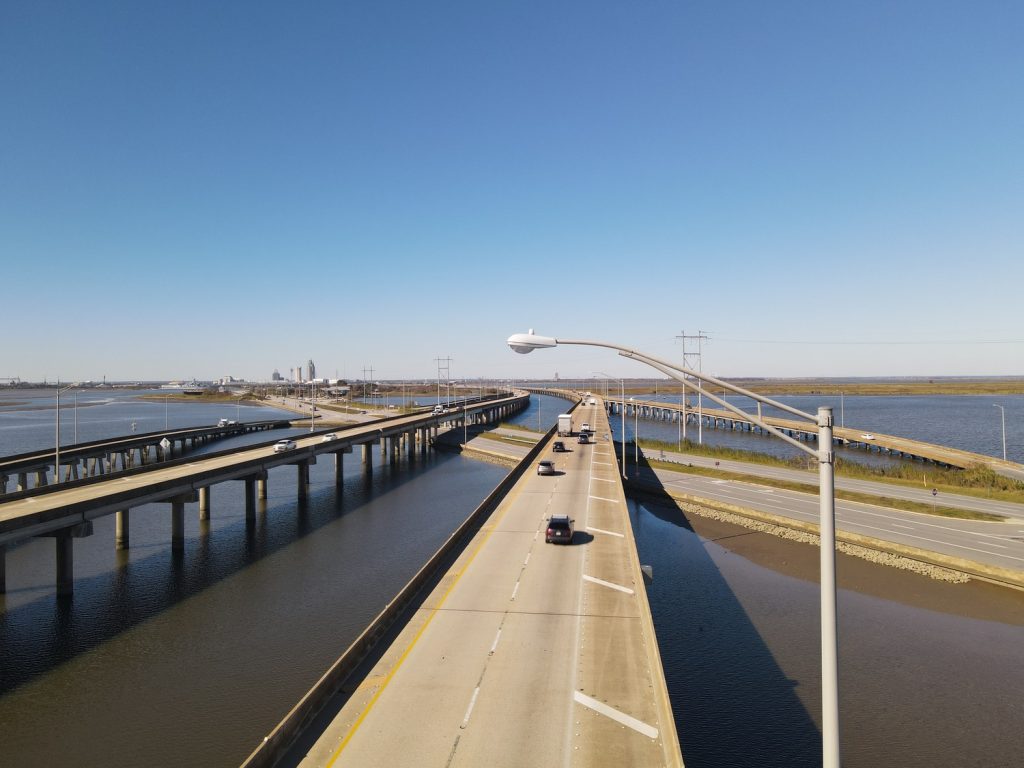
The Mobile River Bridge project represents one of Alabama’s most transformative infrastructure investments, designed to improve mobility, safety, and long-term regional connectivity along the I-10 corridor.
Why the Mobile River Bridge Matters
For decades, the Wallace Tunnel has served as a critical, but constrained, connection through Mobile. The new Mobile River Bridge will introduce an additional cable-stayed river crossing anticipated to significantly reduce congestion on I-10 and its surrounding interchanges.
Beyond easing traffic, the project creates a more efficient route for all vehicle types, including vehicles carrying hazardous materials which are currently restricted from using the Wallace Tunnel. Once complete, the existing tunnel corridor will transition to I-10 Business, enhancing access to Mobile’s Central Business District while allowing through-traffic to bypass downtown congestion.
The Mobile River Bridge project is currently in the final stages of design, with construction beginning soon.
These improvements will strengthen regional mobility, support economic growth, and improve the daily travel experience for residents and freight operators alike.
Sain Associates’ Role
Sain Associates is proud to be part of the Kiewit Massman Traylor team, supporting ALDOT on this landmark project. Our team is leading the planning and design of the project’s Intelligent Transportation Systems (ITS).
Our work includes developing a comprehensive ITS master plan for the entire Mobile River Bridge and Bayway project corridor. In addition, we are delivering detailed design plans to support the construction of ITS infrastructure across the project limits.
Enhancing Safety and Traffic Flow Through ITS
The ITS systems being implemented are critical to maintaining and improving safety, communication, and real-time traffic management along the corridor. Key components include:
- Fiber optic communication networks
- Integration with the regional traffic management center
- Traffic cameras and vehicle detection systems
- Dynamic message signs for real-time traveler information
- Remote weather monitoring stations
- Advanced fog detection and warning systems
One of the most impactful features is the implementation of upgraded variable speed limit systems. During fog events or reduced visibility conditions, these systems will adjust posted speeds to enhance driver safety.
The ITS infrastructure will also include backup power systems, such as generators and battery storage, allowing critical systems to remain operational during outages.
A Complex, Highly Coordinated Effort
A project of this scale and complexity requires continuous collaboration across multiple engineering disciplines. With much of the project occurring on bridge structures, coordination with structural engineering is especially critical.
Unlike traditional roadway projects, many ITS elements—such as cameras, signage, and communication equipment—as well as roadway lighting and electrical systems must be mounted directly onto the bridge. This requires careful planning to identify structurally suitable locations while accommodating the needs of those systems.
Close coordination between ITS and electrical teams is also essential, as the electrical infrastructure provides power to all ITS components. This integrated approach will allow the system to function reliably and efficiently once deployed.
Looking Ahead
As the Mobile River Bridge project moves closer to construction, it stands as a testament to forward-thinking design and collaboration. By combining infrastructure expansion with advanced technology, the project will deliver lasting benefits for mobility, safety, and economic development across the Gulf Coast region.
Sain Associates is honored to contribute to this transformative effort and help shape the future of transportation in Alabama.