
Local governments across Alabama are continually working to make their transportation systems safer, more efficient, and better prepared for growth. Often, the challenge is finding the funding needed to move an important project from an idea to implementation. The Alabama Transportation Rehabilitation and Improvement Program-II, or ATRIP-II, can help bridge that gap.
ATRIP-II provides local governments with an opportunity to pursue funding for eligible road and bridge improvements that benefit Alabama’s state highway system. For communities facing aging infrastructure, congestion, safety concerns, or increasing traffic demands along state routes, the program can be an important resource for advancing needed transportation improvements.
Choosing the Right Project
A strong ATRIP-II application starts with clearly identifying the transportation problem and the improvements needed to address it.
Sometimes that need is already well understood. Local leaders may hear recurring concerns about an intersection, see increased congestion, or know population growth and new development are changing traffic patterns. In other cases, a traffic study or safety evaluation may be needed to better define the issue.
Technical information, such as traffic volumes, crash history, operational conditions, future growth, concept plans, and preliminary cost estimates, can help turn a general concern into a well-supported project. The clearer the need and proposed solution, the stronger the story behind the application.
Supporting an ATRIP-II Application
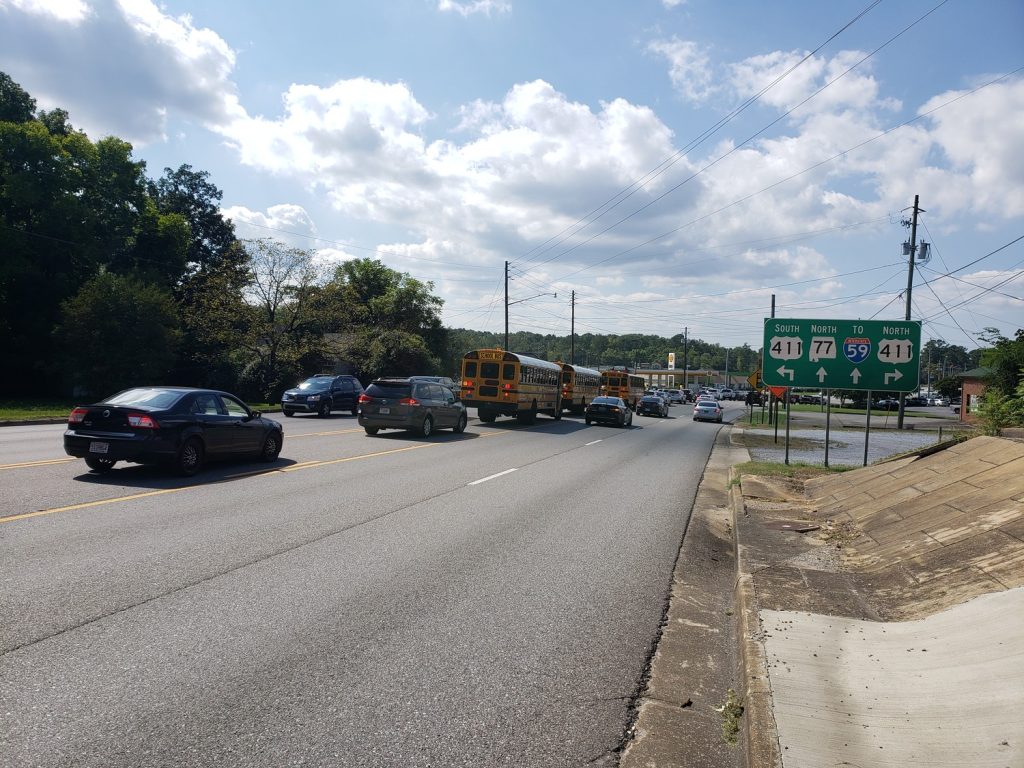
When the City of Rainbow City decided to pursue ATRIP-II funding for improvements at and adjacent to the intersection of US-411 and SR-77, where the City experiences recurring traffic congestion, Sain helped complete the City’s grant application. Our team provided the technical information and project details needed to support the proposed improvements and strengthen the submittal.
We were also able to draw on previous traffic studies our team completed for ALDOT in the area. That work gave us useful background on traffic operations, future conditions, and potential improvements. It also helped us clearly understand the transportation needs the City wanted to address through ATRIP-II.
Following the grant award, Sain continued to support Rainbow City with engineering design services for the scope of work proposed in the ATRIP-II application – roadway resurfacing and traffic signal improvements at several locations along US-411 and SR-77. As part of the project, the intersection of SR-77 and Church Street was signalized and reconfigured to provide an additional option for the heavy left turn demand from US-411 onto SR-77 heading toward Southside.
The project is a good example of how technical analysis and a well-prepared application can help a community advance an identified transportation need toward implementation.
How Sain Can Help
Communities approach ATRIP-II from different starting points. Some already know which project they want to pursue, while others need help evaluating their needs and determining which improvement may be the best fit.
Sain can assist with:
- Evaluating potential projects
- Reviewing traffic and safety conditions
- Developing improvement concepts
- Preparing preliminary construction cost estimates
- Identifying right-of-way, utility, and other project considerations
- Creating maps, exhibits, and technical support materials
- Assisting with the application narrative and supporting documentation
- Coordinating with the local agency and ALDOT as appropriate
Our goal is to help communities develop an application that is clearly defined, technically supported, and focused on a real transportation need.
Moving Your Project Forward
ATRIP-II can be a valuable opportunity for communities to advance transportation improvements that may otherwise be difficult to fund. Starting early, selecting the right project, and building a strong technical foundation can put a municipality or county in a better position to compete for funding and ultimately deliver meaningful improvements for its community.
If your community is considering an ATRIP-II project, now is the time to start the conversation. FY 2027 ATRIP-II applications are due November 13, 2026.
Contact us to discuss your project and how we can help position it for a strong application.